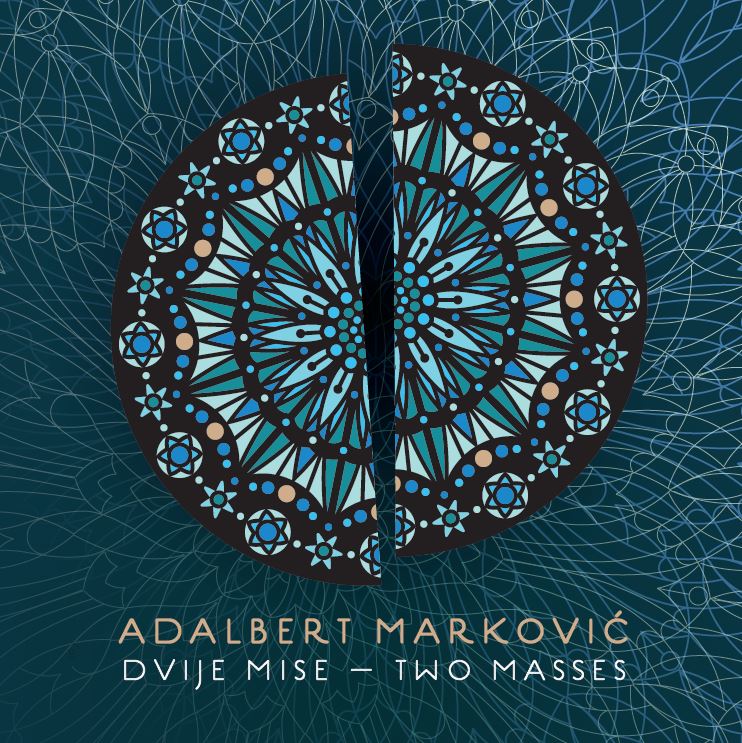
Adalbert Marković: Dvije mise
Marković, Adalbert
Series
Hrvatski suvremeni skladatelji
Type of release
CD
About the release
Pjevački zbor Akademije za umjetnost i kulturu u Osijeku / Choir of the Academy of Arts and Culture in Osijek
Antoaneta Radočaj-Jerković, dirigentica / conductor
Valentina Fridrich, sopran / soprano
Milan Hibšer, orgulje / organ
An important part of Marković’s choral output comprises several works of spiritual character, among them as many as six masses: the first written in 1955, and the last in 1990. The spiritual segment of Marković’s oeuvre reveals the development of the composer’s essential stylistic traits, particularly striking in the two masses featured on this recording. In Marković’s musical language everything is clear, transparent, and unfolds according to the rules of tradition, which the composer respected and from which he rarely deviated. He valued formal clarity and a well‑defined structure, grounding this clarity primarily in principles inherited from tradition.
However, in both masses on this recording the composer omitted the Credo. Today it is almost impossible to determine why: was he expressing personal questions or doubts, or did the musical material itself dictate a particular sequence of musical events? Memories of the composer and of his artistic and personal views favour the latter explanation, which is in a way confirmed not only by the formal clarity of the individual movements but also by his effort to set in motion events within each movement that enliven it in a specific way — whether through modulation, imitations, or motives. A defining feature of Marković’s vocal‑instrumental music is the firm and lucid connection between musical flow and text. “Marković’s attention is directed toward the dramaturgy of musical form, which entrusts individual motifs and musical phrases with strong kinetic energies that, in the manner of human speech, always propel its unique musical flow forward.” (Borko Špoljarić, commentary to the CD Adalbert Marković: Moments musicaux, HDS/MBZ/HDS, Zagreb, 1999.)
In both masses, the organ part is not merely a support, but is firmly embedded in the polyphony, while the soprano solo in the Croatian Mass – John Paul II for women’s choir, soprano solo and organ (1982) functions more as an individual prayer that rises above and joins the ensemble’s singing. In his spiritual oeuvre — both in quantity and artistic value — Marković stands as a successor to the most prominent Croatian composers of sacred music in the 20th century, such as Anselmo Canjuga and Albe Vidaković. Without doubt, the greatest value of this music lies in live performance. As the distinguished Varaždin professor and choir conductor Dada Ruža observed: “This is an oeuvre that continues to live and resonate in choir programmes just as vividly as it did during the composer’s lifetime, carrying on now that his life has ended — from modest school performances all the way to the most prestigious international competitions.” (Quoted in David Rožmarić: Adalbert Marković: Hrvatska misa in D, https/zir.nsk.hr – accessed 25 April 2022.)
(Erika Krpan)
Croatian Composer’s Society, Cantus d.o.o., 2022.
8924504442
Works
-
Hrvatska misa in D – Hvalite Gospodina za mješoviti zbor i orgulje / Croatian Mass in D – Praise the Lord for mixed choir and organ
-
Hrvatska misa – Ivan Pavao II. za ženski zbor, sopran solo i orgulje / Croatian Mass – John Paul II for women’s choir, soprano solo and organ
Discography