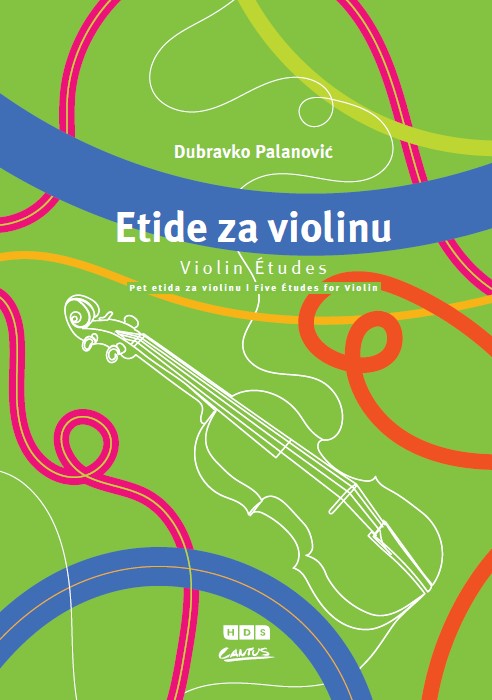
Dubravko Palanović: Etudes for Violin


About the release
Etudes for Violin are designed to follow the technical requirements that accompany them through years of study, but also the desire to love the violin. In addition to the technical requirements in the etudes, interpretative ones are also set.
The first etude deals with jumps over the strings and combined legato – staccato techniques, where the original material is constantly varied in different combinations. The purpose of the second etude is to make the left hand elastic in a technical sense, considering the frequent alterations and chromatics. The third etude primarily deals with double grips, but there are also elements of the integrity of the right hand, since the right hand must have a fairly high tone intensity for such situations. The fourth etude deals with various bow strokes at a relatively fast tempo, but there are also demanding elements for the left hand, considering the fast tempo, alterations, chromatics and double grips. I think that the fifth etude somewhat encompasses all the elements of the previous etudes and requires greater technical and musical preparation, and it also has a more complex formal structure.
Dubravko Palanović, prof.
Dubravko Palanović’s five solo violin etudes are conceived more as violinist miniatures and less as dry technical exercises. They are written in Palanović’s very recognisable harmonic and melodic style with a lot of alterations. Also, Palanović often puts the rhythm in the foreground, thus adding charge and mobility.
The level of difficulty of an etude does not consist in many diverse and different types of technique, although they are also present: double-takes, polyphony, fast detaches, spiccato, chords… The real challenge is in the more complicated notation, which also implies more difficult memorisation of compositions. It seems that Palanović does not want to prepare young violinists for the usual, virtuoso type of playing, but wants to teach them how to approach more modern compositions, in which reading the text and memorising it requires a lot of effort. Pupils and students who encounter 20th century compositions for the first time regularly have a lot of problems with reading the text and correct rhythm, which they usually did not encounter in baroque, classical and romantic compositions. In this way, the young violinist will delicately enter the textual language of more contemporary music.
Regardless of the distinctive style, the etudes are arranged by skill level required, and also by their duration. The first etude is written in the first position, with an impressive rhythmic motif. Detache over the strings is the main technical challenge, with attention to exact dynamics. The second etude requires good motor skills, written in a semiquaver pulse, with many alterations and with many rather complicated chromatic sequences. The main challenge of the third etude, marked Adagio, is the double notes and the encounter with polyphony. This etude is of a calmer and more melodic character, which will be very challenging for the violinist, considering that he has to play two strings in double notes and thus phrase. The fourth etude is somewhat longer and more complicated, with a meno mosso in the middle, which requires the violinist to slow down naturally and logically, and then return to the tempo primo. The beginning is again characterised by a very clear rhythmic motif. Among the technical difficulties, there are alterations that are very unusual for a violinist, spiccato over the strings, chords with a quick change of strings… The fifth etude is the longest, with the most musical text and an abundance of rhythmic challenges. The tempo is rather fast: Allegro, and it is written in six-eighth and three-quarter time, often with a shifted heavy beat in the measure, which will create certain rhythmic difficulties for the performer. The performer is required to be quick, dexterous, but also to respect dynamic markings and to play the rhythm accurately.
Recommended for you